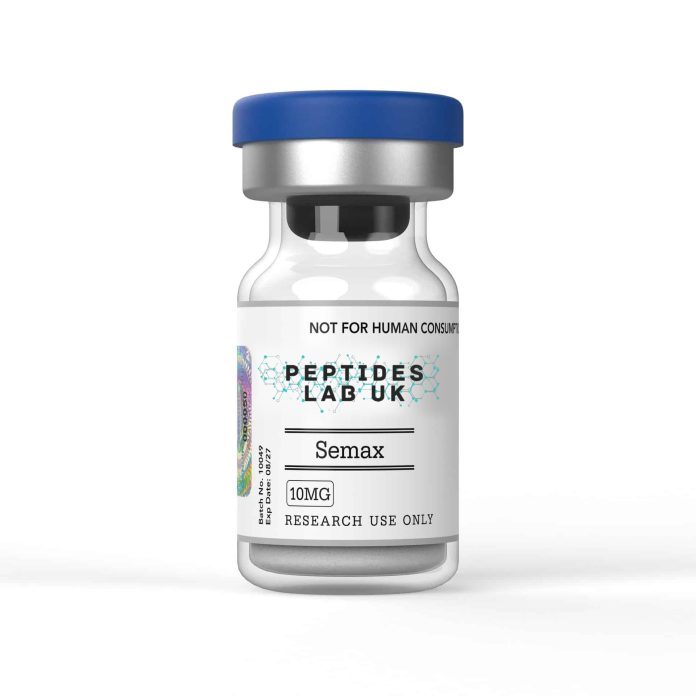

Semax (Met-Glu-His-Phe-Pro-Gly-Pro) is a synthetic heptapeptide analogue of the adrenocorticotropic hormone fragment ACTH(4-10), in which the native C-terminal Arg-Trp-Gly sequence has been replaced with a Pro-Gly-Pro tripeptide. This substitution confers marked resistance to enzymatic degradation by plasma peptidases while eliminating the corticotropic hormonal activity associated with native ACTH. Peptides Semax research is centred on its reported effects on brain-derived neurotrophic factor (BDNF) expression and downstream TrkB receptor signalling, positioning it as a tool compound for studying neurotrophic and neuroprotective signalling pathways in preclinical models.
What Are Peptides Semax?
Semax is derived from the N-terminal fragment of adrenocorticotropic hormone spanning residues 4 to 10, a region referred to as ACTH(4-10), which in its native form has the sequence Met-Glu-His-Phe-Arg-Trp-Gly. In the Semax analogue, the C-terminal Arg-Trp-Gly tripeptide is substituted with Pro-Gly-Pro, producing the final heptapeptide sequence Met-Glu-His-Phe-Pro-Gly-Pro. This structural modification is central to Semax’s research profile for two related reasons. First, the Pro-Gly-Pro substitution confers substantial resistance to plasma peptidase degradation, extending the peptide’s biological activity relative to unmodified ACTH fragments, which are rapidly cleaved under physiological conditions. Second, the modification removes the corticotropic activity that native ACTH exerts at the melanocortin-2 receptor (MC2R) in the adrenal cortex, meaning Semax does not stimulate cortisol release or produce the systemic hormonal effects associated with the parent hormone.
Researchers have reported that Semax retains weak activity at other melanocortin receptor subtypes, including MC3R and MC4R, at levels substantially reduced relative to native ACTH, though this residual melanocortin activity is not considered central to its principal research applications. A structurally related compound, referred to in some sources as Semax lacking hormonal ACTH activity, has additionally been characterised as an antagonist at MC4R in receptor pharmacology studies, a finding relevant to researchers designing comparative melanocortin receptor assays involving Semax.
A further structural property relevant to laboratory research is Semax’s capacity to cross the blood-brain barrier following intranasal or systemic administration in animal studies, a property attributed to its small heptapeptide size and specific binding characteristics rather than to any active transport mechanism unique to the molecule. Receptor-binding studies using rat basal forebrain membrane preparations have identified specific, time-dependent, calcium-dependent and reversible binding sites for tritium-labelled Semax, with reported binding affinity in the low nanomolar range, providing pharmacological evidence for a specific, receptor-mediated mode of action distinct from simple diffusion across neuronal membranes.
Mechanism of Action
The most extensively documented mechanism associated with Semax in the published literature is upregulation of brain-derived neurotrophic factor (BDNF) and activation of its high-affinity receptor, tropomyosin receptor kinase B (TrkB). Research using intranasal Semax administration in rats has reported that a single application produces a measurable increase in hippocampal BDNF protein levels, alongside increased tyrosine phosphorylation of TrkB, the activating post-translational modification associated with receptor signalling. At the transcriptional level, the same research has reported substantial increases in both exon III BDNF mRNA and TrkB mRNA in hippocampal tissue, indicating that Semax’s effects on the BDNF/TrkB system operate at both the transcriptional and post-translational level.
Beyond the hippocampus, research has reported that Semax stimulates BDNF expression across multiple brain regions in vivo, indicating that its neurotrophic signalling effects are not confined to a single anatomical structure. Nerve growth factor (NGF) synthesis has also been documented as part of Semax’s broader neurotrophin-signalling profile, with research using models of cerebral ischemia reporting upregulated expression of NGF and NT-3 alongside their corresponding high-affinity receptors, TrkA, TrkB and TrkC, suggesting that Semax’s neurotrophic activity extends across multiple related neurotrophin signalling systems rather than being restricted to BDNF and TrkB alone.
Dopaminergic and serotonergic system modulation represents a second major mechanistic axis documented in the Semax literature. Research examining monoamine neurotransmitter systems in rodents has reported that Semax activates both dopaminergic and serotoninergic brain systems, findings proposed to contribute to the compound’s reported effects on learning and memory paradigms in animal behavioural research, operating in parallel to, and potentially interacting with, its neurotrophin-upregulating activity.
Enzymatic degradation resistance, discussed structurally above, is itself considered a mechanistic contributor to Semax’s research profile, since the Pro-Gly-Pro modification extends the peptide’s functional half-life relative to native ACTH fragments, allowing sustained receptor engagement and downstream signalling activation following a single administration in experimental protocols. Researchers have also proposed that Semax may act through G-protein-coupled receptor signalling, based on downstream transcriptional patterns consistent with cAMP-response-element-binding protein (CREB)-dependent gene activation, including the CREB-dependent regulation known to govern BDNF exon III transcription, though the specific receptor mediating Semax’s neurotrophic effects has not been definitively identified in the published literature.
What the Research Shows
The foundational hippocampal mechanism study was published by Dolotov and colleagues in Brain Research, reporting that a single intranasal application of Semax at 50 micrograms per kilogram body weight produced a maximal 1.4-fold increase in hippocampal BDNF protein levels, alongside a 1.6-fold increase in TrkB tyrosine phosphorylation and increases of 3-fold and 2-fold in exon III BDNF and TrkB mRNA levels respectively; Semax-treated animals also showed increased conditioned avoidance reactions in behavioural testing (Semax hippocampal BDNF/TrkB study).
An earlier study by the same research group, examining Semax’s effects across different brain regions in vivo, reported that the heptapeptide stimulates BDNF expression at multiple anatomical sites beyond the hippocampus, establishing that its neurotrophic signalling activity is not confined to a single brain structure (SEMAX brain-wide BDNF expression study).
Gene-expression research examining Semax’s effects in a rat model of focal cerebral ischemia used genome-wide analysis to characterise transcriptional changes associated with the immune and vascular systems in brain tissue following Semax administration, providing a broader molecular picture of the peptide’s neuroprotective gene-expression profile beyond the BDNF/TrkB axis alone, in a model relevant to ischemic stroke research (Semax ischemia gene-expression study).
Cognitive domain testing in rodents has been reported across several of the studies referenced above, using standardised behavioural paradigms, including conditioned avoidance reaction testing, to assess learning and memory outcomes following Semax administration, with researchers linking cognitive performance changes to the underlying neurotrophin-signalling mechanism rather than treating behavioural and molecular findings as independent lines of evidence. Vascular response pathways have also been examined in the Semax literature, with research reporting modulation of vascular endothelial growth factor (VEGF-A) mRNA levels in frontal cortex and hippocampal tissue, suggesting that Semax’s research profile extends to angiogenic and vascular signalling in the brain in addition to its neurotrophin and behavioural effects.
Research Applications
Within laboratory settings, Semax research peptide is used across several distinct neuroscience research contexts. Neuronal cell culture survival assays represent a core application, in which researchers examine cell viability and survival markers in cultured neuronal or astrocyte populations following Semax exposure, often under conditions of induced metabolic or oxidative stress designed to model neurodegenerative or ischemic injury. BDNF expression profiling constitutes a further major application, using techniques such as quantitative PCR, Western blot and ELISA to characterise Semax’s effects on BDNF and TrkB expression and phosphorylation status across different brain regions and experimental conditions, building directly on the hippocampal mechanism findings described above.
Oxidative stress neuroprotection models are used to examine Semax’s activity in preclinical models of ischemic or hypoxic neuronal injury, frequently employing rodent models of cerebral ischemia to assess neuroprotective gene-expression changes and functional outcomes following peptide administration. Synaptic plasticity assays represent a further research context, in which researchers examine markers of synaptic strength and structural plasticity, often in conjunction with behavioural learning paradigms, to characterise how Semax’s neurotrophin-signalling activity may relate to functional changes in synaptic connectivity. When selecting a certified Semax research peptide for neuronal culture or neurotrophic factor assays, researchers should confirm the exact heptapeptide sequence and purity documentation supplied, since the specific Pro-Gly-Pro C-terminal modification is central to reproducing the enzymatic stability and receptor-binding characteristics reported in the primary literature.
Comparative pharmacology work has also examined Semax alongside related synthetic ACTH-derived heptapeptides sharing the same Pro-Gly-Pro stabilising modification, providing researchers with a broader comparative framework for studying structure-activity relationships within this class of neurotrophin-modulating peptide compounds.
Purity, Storage and Handling
Research-grade Semax should be accompanied by a certificate of analysis confirming purity by HPLC, typically at or above 98 percent, together with mass spectrometry verification confirming the correct seven-amino-acid sequence and the Pro-Gly-Pro C-terminal modification that distinguishes Semax from unmodified ACTH(4-10) fragments. Because this specific structural modification underlies both the enzymatic stability and receptor-binding characteristics reported in the primary literature, analytical confirmation of the correct sequence is particularly relevant to reproducing published BDNF/TrkB signalling findings. When sourcing high-purity peptides semax for laboratory assays, UK researchers should verify that each batch includes this documentation rather than relying on a generic product listing.
Lyophilised Semax should be stored at -20°C, protected from light and moisture, in order to preserve peptide integrity prior to reconstitution. Reconstitution should be carried out using sterile water or an appropriate buffer solution consistent with the intended experimental protocol, and researchers should follow supplier-specific reconstitution guidance to maintain consistency with published research methodology. Once reconstituted, solutions should be refrigerated at 2-8°C, used within the supplier’s stated stability window, and protected from repeated freeze-thaw cycling through appropriate aliquoting, since enzymatic and physical degradation can still occur in reconstituted solutions despite the peptide’s enhanced resistance to plasma peptidase activity relative to unmodified ACTH fragments.
Frequently Asked Questions
What structural modification distinguishes Semax from native ACTH(4-10)?
Semax replaces the native C-terminal Arg-Trp-Gly sequence of ACTH(4-10) with a Pro-Gly-Pro tripeptide. This substitution confers substantial resistance to plasma peptidase degradation while removing the corticotropic hormonal activity that native ACTH exerts at the melanocortin-2 receptor.
How does Semax affect BDNF expression in research models?
Published research reports that intranasal Semax administration in rats increases hippocampal BDNF protein and mRNA levels, alongside increased tyrosine phosphorylation of the TrkB receptor. These effects have been documented across multiple brain regions rather than being confined to the hippocampus alone.
Does Semax retain the hormonal effects of ACTH?
No. The Pro-Gly-Pro structural modification removes the corticotropic activity associated with native ACTH at the melanocortin-2 receptor, meaning Semax does not stimulate cortisol release. Some residual, substantially reduced activity at other melanocortin receptor subtypes has been reported in the pharmacology literature.
How should research-grade Semax be verified before use in an assay?
Researchers should request a batch-specific certificate of analysis confirming HPLC purity of 98 percent or higher and mass spectrometry confirmation of the correct heptapeptide sequence, including the Pro-Gly-Pro modification, since sequence accuracy is central to reproducing the BDNF/TrkB signalling findings reported in the primary literature.
Peptides Semax, as supplied by Peptides Lab UK and comparable UK research suppliers, are intended strictly for in-vitro and animal-model laboratory research. They are not licensed or intended for human or veterinary use, and nothing in this article should be interpreted as guidance for personal administration.