
The phrase “AI-powered SEO” has been so thoroughly overused that it’s essentially stopped meaning anything. Every tool from the mid-tier to the enterprise level slaps some version of that label on their homepage. Automated keyword clustering? AI. Content scoring? AI. Site speed recommendations? Somehow also AI, apparently.
So when the term “hyper intelligence SEO” started appearing in more serious conversations, a lot of people’s first instinct was to roll their eyes. Just another rebrand. Just another way to charge more for the same dashboards.
That skepticism is understandable. It’s also, upon closer inspection, a bit misplaced.
What Machine Learning SEO Actually Does (and Doesn’t Do)
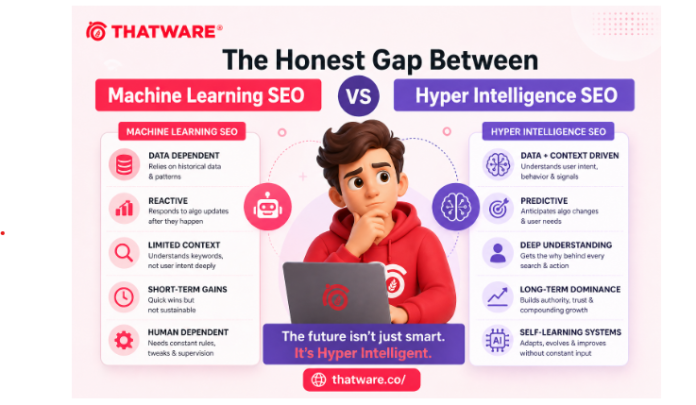
Machine learning SEO, in its most honest description, is pattern recognition at scale. The models are trained on historical ranking data – what kinds of content ranked for what kinds of queries under what kinds of link profiles – and they surface predictions and recommendations based on those patterns. It’s genuinely useful. It’s also fundamentally backward-looking. You’re optimizing for patterns that already exist in the data, which means you’re always chasing what worked, never quite ahead of what will work.
Hyper intelligence SEO operates from a different premise. Rather than just pattern-matching against historical data, it attempts to model intent – the actual cognitive and behavioral states behind a search query. Not just “what did people search” but “why, in what context, with what mental model, and what would actually satisfy that intent at a deep level.”
That’s not a trivial distinction.
A Concrete Example: CRM Keywords and Hyperintelligence SEO Services
Here’s a concrete example. A traditional ML SEO tool might tell you that pages ranking for “best CRM for small business” tend to have around 2,000 words, include comparison tables, and earn backlinks from software review sites. Useful.Hyperintelligence seo services would try to model why the person searching that phrase is searching it – what stage of decision they’re at, what emotional weight the decision carries (fear of wasting money, pressure to justify a spend to a boss), and what answer format would actually resolve their state, not just match their query.
The content produced from that second framework looks different. It’s more narrative. It addresses doubt more directly. It structures decision-making in a way that mirrors how humans actually decide, not just how they type.
Does It Actually Rank Better?
Does it rank better? That’s the honest question. And the honest answer is: it depends, but often yes – for a very particular reason.
Google’s ranking systems have gotten significantly better at detecting user satisfaction signals. Not just clicks and bounce rates, but deeper behavioral proxies for “this result actually helped.” Dwell time, scroll patterns, subsequent search behavior. When content is genuinely built around user intent at a deep level, it tends to perform better on those satisfaction signals, which feeds back into rankings.
Machine learning tools optimize for the surface features of high-ranking content. Hyper intelligence approaches try to optimize for the underlying reason that content performs well – and that’s a more durable advantage.
The Implementation Reality: Harder, But Worth It
The implementation is harder, though. I’ll be honest about that.
Building content through an HI lens requires more upfront research. More qualitative work – actual user interviews, search behavior analysis, mental model mapping. It’s slower than dumping a keyword list into a content generation tool and scheduling 50 posts for the month.
But for brands operating in competitive niches where generic well-structured content just isn’t enough to move the needle? It’s often the difference between a content strategy that plateaus and one that compounds.
What HI SEO Services Actually Deliver
HI SEO services – when delivered properly – involve a combination of technical SEO fundamentals, deep intent research, and content architecture that maps to cognitive decision pathways. It’s not a silver bullet. Nothing in SEO is. But it represents a more sophisticated answer to the question: “why do some content strategies work for years while others peak and fade?”
The gap between ML SEO and HI SEO isn’t really about the tools. It’s about the mental model underlying the strategy. One asks “what does good content look like?” The other asks “what does this specific human need to think, feel, and understand to be genuinely served by this content?”
That’s a harder question. And the brands willing to sit with harder questions tend to build better search presences. It’s been true for years. The tools have gotten fancier, but the principle hasn’t changed.