
Take a prescription bottle, a vaccine vial or an over-the-counter tablet and chances are the company whose logo is on the label didn’t make the product. Sometimes people are surprised by that. The tendency is to imagine large pharmaceutical companies as factories that produce all pills, all injections and all biologics in-house. Reality is more complex.
Pharmaceutical contract manufacturing is one of the silent forces that shape the healthcare industry. It is a world of partnerships, of specialized production expertise, of regulatory discipline, and a constant balancing act between speed, cost and quality. This side of pharma is rarely seen by the public, but it underpins many of today’s medicines.
The Real Meaning of Pharmaceutical Contract Manufacturing
Pharmaceutical contract manufacturing is simply a process where the production of drugs is outsourced to external manufacturing organizations. These companies are often referred to as CMOs, or Contract Manufacturing Organizations, though some operate as CDMOs, which provide development services in addition to manufacturing. The idea is straightforward.
A pharmaceutical company develops or markets a drug product but contracts a specialized manufacturer to manufacture some or all of the product. Such support can be for active pharmaceutical ingredients, finished dosage forms, sterile injectables, packaging, analytical testing or process development. Why outsource something as important as the manufacture of medicine?
The short answer is practicality. Building pharmaceutical production facilities is costly, technically difficult and highly regulated. Not every company wants to spend billions on infrastructure when specialized partners already have the equipment, expertise and regulatory regimes in place.
Contract manufacturing lets pharmaceutical companies concentrate on research, clinical development, commercialization or market strategy, leaving the complexities of manufacturing to the experts. This kind of division of labor is becoming more common across the industry.
Why Outsourcing Is So Important in Pharma
The pharmaceutical environment is changing rapidly. The drug development pipelines are becoming more diverse. Biology is on the rise. We are witnessing the rise of personalized therapies. The timelines remain challenging. Flexibility is important in that context. Contract manufacturing enables companies to expand production capacity without having to construct new facilities for each product or therapeutic platform.
This model is particularly beneficial for small biotechnology firms. A startup with a promising therapy may have state-of-the-art science but limited manufacturing infrastructure. That gap can be filled by a partner with experience in contract manufacturing. Pharmaceutical companies even outsource a lot of stuff.
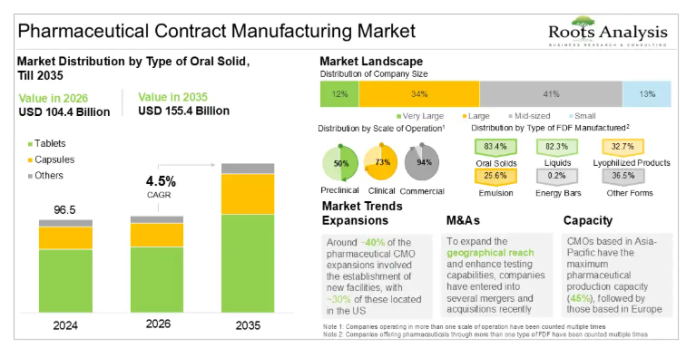
I came across Roots Analysis, and they mentioned that this market continues to expand due to the rising complexity of pharmaceuticals. The global pharmaceutical contract manufacturing market size, valued at USD 100.3 billion in 2025, is projected to reach USD 104.4 billion in 2026 and USD 155.4 billion by 2035, registering a CAGR of 4.5% during the forecast period of 2026 to 2035. Those numbers are more than just business growth. They are a sign of how much outsourcing has become woven into the fabric of modern pharmaceutical operations.
The trend is not just about cutting costs. Expertise, speed and scale often matter just as much to these partnerships.
Medicines Are More Complicated to Make Than They Seem
“Sometimes people outside the pharmaceutical industry think of manufacturing as a fairly repetitive industrial process”. Pharmaceutical manufacturing is anything but simple. All steps are subject to rigorous quality standards, comprehensive documentation, validated processes, environmental monitoring, and regulatory oversight. A small process variation can have serious consequences.
Contract manufacturers are pressured to deliver consistency across production runs as well as timelines, customer expectations and changing compliance standards. Different product categories have different technical requirements. Sterile injectables are produced in highly controlled environments. The production of biologics adds living systems and process sensitivity. Oral solid dosage forms have their own scale and formulation challenges in their manufacturing.
Then there’s supply chain coordination. Raw materials, packaging components, testing schedules, logistics plans and regulatory submissions must all be in sync. If one piece goes, the timelines can shift fast. Those who work in the pharmaceutical manufacturing industry often describe it as a combination of engineering, science, project management and controlled chaos. That description is surprisingly honest.
Trust and Quality are the Core of Every Partnership
Relationships are everything in pharmaceutical contract manufacturing. A drug sponsor is not just hiring a factory. It trusts another organization with the quality of its product, the safety of its patients, its intellectual property and regulatory compliance. That trust has to be built. Audits, technical due diligence, quality agreements, and communication frameworks are all critical elements in building strong manufacturing partnerships.
Regulatory inspections represent another layer of accountability. GMP is good manufacturing practice and is a requirement for manufacturing facilities. These standards are intended to ensure that products are produced and controlled consistently to the quality standards appropriate for their intended use.
As one industry veteran once said, pharmaceutical manufacturing is “an industry where the details that no one notices are often the most important.” That’s true to some degree. Patients may never see production records, environmental monitoring data or validation protocols. But those unseen systems determine whether medicines are up to the standards health care depends on.
Contract Manufacturing is Changing with Technology Change
The pharmaceutical contract manufacturing landscape is changing with technology change. Automation, digital quality systems, advanced analytics, continuous manufacturing approaches, and data-driven process monitoring are increasingly important. Manufacturers are investing in smarter production environments that increase efficiency, lower the risk of human error and enhance traceability.
Service needs are also being impacted by biopharmaceutical growth. With the growth of gene therapies, cell therapies and biologics, contract manufacturers are developing more specialized capabilities. This evolution presents opportunities but also raises the bar. To keep up with technology, you need capital investment, skilled personnel, training programs and continuous process adaptation. The pace of change can be difficult, particularly for organizations that operate across several therapeutic areas and regulatory jurisdictions. But you cannot ignore innovation.
The Human Side of Outsourcing Pharmaceutical Manufacturing
It’s easy to talk about pharmaceutical contract manufacturing in terms of facilities, market growth and operating models. But behind each production line are people with enormous responsibility. Manufacturing scientists, quality specialists, engineers, validation experts, operators, regulatory professionals and supply chain teams are involved in the process. Deadlines matter because medicine matters.
Delays may impact clinical trials, product launches or patient access. Quality problems have clear consequences. Pharmaceutical manufacturing has a quiet seriousness that outsiders don’t always appreciate. Those in the field know that they are not making ordinary consumer products. They are helping deliver therapies that patients can count on in some of the toughest moments of their lives. That view shapes the culture more than most people realizes.
Conclusion: The Invisible Infrastructure of Modern Pharma
Pharmaceutical contract manufacturing might not be a topic that gets a lot of public attention, but it is an important part of the development, production and delivery of modern medicines. It provides companies with specialized expertise, scalable capacity and manufacturing flexibility in an increasingly complex healthcare environment.
It is a tough job and highly regulated and very connected to patient outcomes. With pharmaceutical innovation moving into biologics, personalized medicine and advanced therapies, the need for contract manufacturing will probably grow even more. This is a quietly fascinating sector.
It’s largely unglamorous work that happens behind the scenes, away from marketing campaigns and product launches, but it’s what helps turn scientific breakthroughs into real medicines that can make it to hospitals, clinics and patients across the globe. Pharmaceutical contract manufacturing is, in many ways, more than just a business service. It is part of the behind-the-scenes infrastructure that keeps modern healthcare going.